
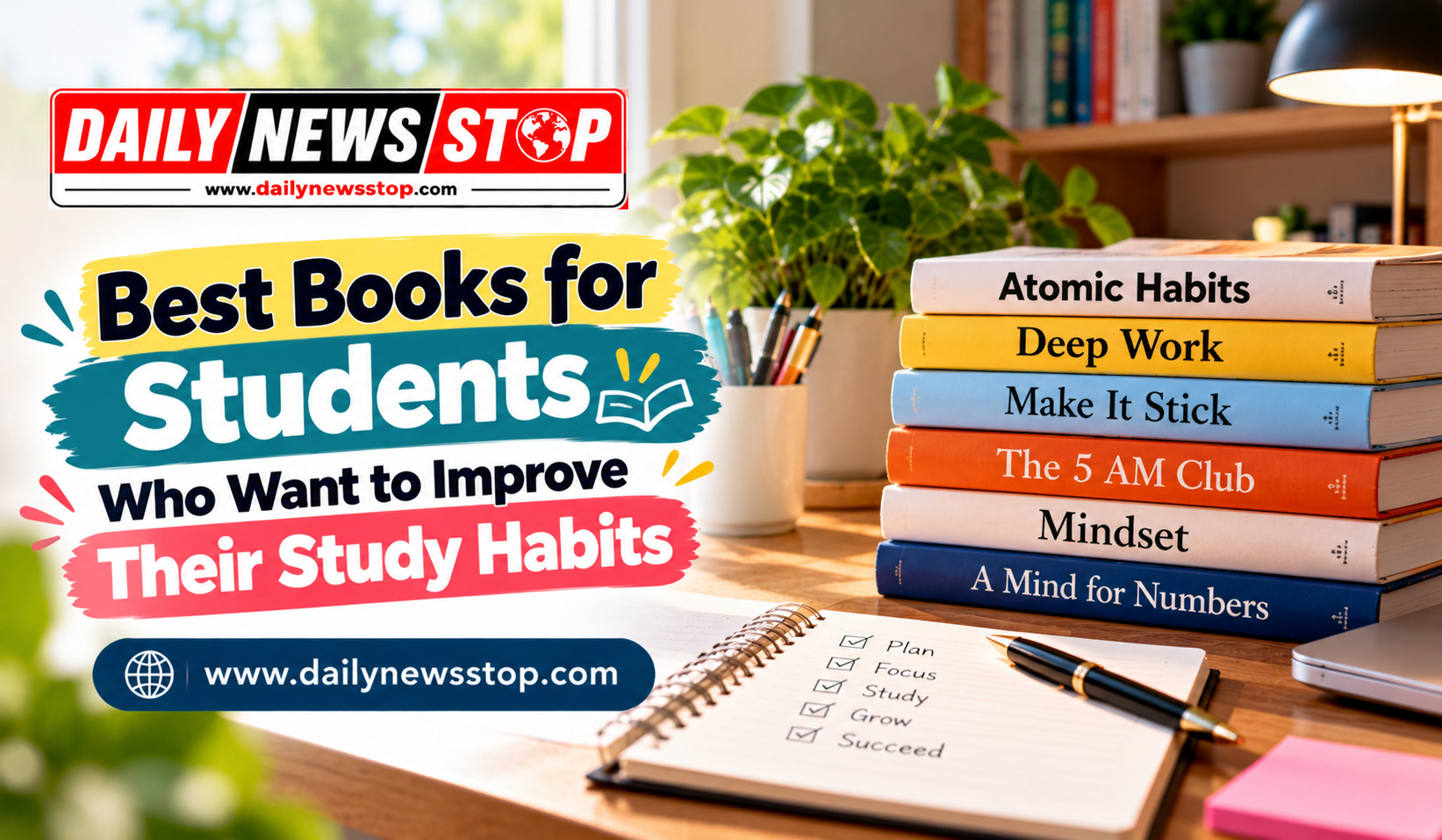
Good study habits can make a big difference in a student’s academic life. However, studying for long hours does not always lead to better results. The way students manage their time, understand information, revise lessons, and prepare for examinations often matters more than the number of hours they spend studying. The best books for students who want to improve their study habits can offer practical ideas to make learning easier, more organised, and more effective.
Many students struggle with distractions, procrastination, poor time management, or difficulty remembering what they have learned. Fortunately, books about learning techniques, productivity, memory, and personal development can help students understand these challenges and find useful solutions.
Moreover, different students have different learning needs. Some need help creating a daily routine, while others want to improve concentration or remember information for longer. Choosing books based on these needs can help students develop better routines and become more confident learners.
1. Books About Building Daily Study Habits
Developing a regular study routine is one of the most important steps towards academic improvement. However, students often begin with ambitious plans that become difficult to maintain. Books about habit formation explain how small, repeated actions can gradually become part of everyday life.
These books encourage students to focus on consistency instead of expecting immediate results. For example, studying for 20 minutes every evening can be more manageable than planning to study for three hours and repeatedly postponing the session.
What students can learn
- Create a regular time and place for studying.
- Break large academic tasks into smaller activities.
- Prepare books, notebooks, and stationery before starting.
- Track daily progress to recognise improvement.
- Reduce activities that interrupt the study routine.
Furthermore, students can connect studying with an existing daily activity. Someone who reviews class notes after returning home may find it easier to maintain the habit than someone who studies only when motivation appears.
These books are especially useful for students who struggle with consistency or frequently leave assignments until the last minute.
2. Books About Memory and Effective Learning
Reading a chapter several times does not always mean a student will remember it during an examination. Sometimes, information feels familiar while reading but becomes difficult to recall without looking at the page.
Books about memory and learning explain how students can practise retrieving information, revisit lessons at suitable intervals, and strengthen their understanding through active participation.
Useful learning techniques
Self-testing: After reading a chapter, close the book and answer questions from memory. Then check your answers and review anything you missed.
Spaced revision: Revisit important topics over several days instead of studying everything in one long session before an examination.
Practice questions: Apply what you have learned by answering questions, solving problems, or explaining concepts in your own words.
Summarising information: Write short summaries that highlight the main ideas instead of copying entire paragraphs from textbooks.
For example, a student studying history could read about an important event, close the textbook, and write down its causes, key developments, and effects. After checking the notes, the student could repeat the exercise a few days later.
Consequently, learning becomes an active process rather than a routine of repeatedly reading the same information.
3. Books About Concentration and Focus
Distractions can make studying unnecessarily difficult. Notifications, social media, background noise, and frequent conversations may interrupt concentration. As a result, students sometimes spend an entire evening studying without completing much work.
Books about concentration explain how to protect attention and create an environment that supports focused learning.
Ways to improve concentration
- Keep your phone away during important study sessions.
- Choose a quiet and comfortable place to work.
- Set one clear goal before opening your textbook.
- Divide long study periods into manageable sessions.
- Take planned breaks instead of switching activities constantly.
For instance, a student preparing for a mathematics test could spend 30 minutes solving practice questions without checking messages. After completing the session, the student could take a short break and then review the incorrect answers.
Additionally, students should understand that concentration develops through practice. It is not necessary to study for several hours without stopping. Instead, begin with a realistic period of focused work and gradually increase it when comfortable.
Books in this category can help students who feel distracted, lose track of tasks, or struggle to finish assignments on time.
4. Books About Time Management and Planning
Students often have several responsibilities at once, including classes, homework, projects, examinations, and personal activities. Without a clear plan, important tasks can become overwhelming.
Books about time management teach students how to organise responsibilities, set priorities, and divide large assignments into smaller steps.
Practical lessons students can apply
Create a weekly schedule: Write down classes, assignment deadlines, revision periods, and other commitments.
Set realistic goals: Decide what you want to complete during each study session rather than creating a long list of vague tasks.
Prioritise important work: Begin with assignments or subjects that require more attention or have closer deadlines.
Avoid last-minute preparation: Divide major projects into research, writing, editing, and final review.
For example, a student who has a science assignment and two examinations in the same week could assign specific time slots to each task. This approach helps prevent one responsibility from taking up all the available study time.
Moreover, a good schedule should include sleep, meals, exercise, and relaxation. Students need enough rest to maintain attention and manage academic pressure.
5. Books About Motivation and Personal Discipline
Motivation often changes from day to day. Students may feel excited about a new academic goal but lose interest when the work becomes difficult. Books about motivation and discipline explain how to continue working even when enthusiasm decreases.
These books often encourage students to understand their goals, recognise their progress, and focus on actions they can control.
How these books can help
- Set clear and meaningful academic goals.
- Divide challenging goals into smaller milestones.
- Recognise progress instead of focusing only on final marks.
- Develop routines that do not depend entirely on motivation.
- Learn from disappointing results instead of giving up.
For example, a student who wants to improve in English could set a daily goal of learning a few new words, reading a short passage, and writing several sentences. Over time, these manageable activities can support steady progress.
However, discipline does not mean studying continuously without rest. Students should balance effort with recovery and seek help when they feel overwhelmed.
Books about motivation are particularly useful for students who struggle to begin tasks, give up quickly, or find it difficult to maintain long-term goals.
6. Books About Learning Difficult Subjects
Some subjects require more than memorisation. Mathematics, science, accounting, and other technical areas often involve understanding concepts, recognising patterns, and solving problems.
Books about learning difficult subjects help students approach challenging material step by step. They explain why practising problems, reviewing mistakes, and connecting new information with existing knowledge can improve understanding.
Techniques for understanding difficult topics
- Divide complicated concepts into smaller parts.
- Review the basic ideas before moving to advanced material.
- Work through examples before attempting questions independently.
- Identify mistakes and understand their causes.
- Ask teachers or classmates for clarification when necessary.
Suppose a student finds algebra difficult. Instead of repeatedly attempting a complex question, the student could review the relevant formula, solve a simpler example, and then return to the original problem.
Similarly, a science student could draw diagrams, explain a process aloud, and answer practice questions to check understanding.
These books can also help students develop patience. Difficulty with a subject does not automatically mean a student lacks ability. Often, a different explanation or more structured practice can make the topic easier to understand.
7. Books About Positive Thinking and Learning from Mistakes
Fear of failure can prevent students from asking questions, trying difficult problems, or participating in class. Some students interpret a low score as proof that they cannot improve. However, mistakes can reveal which topics need more attention.
Books about positive thinking and personal growth encourage students to approach challenges with curiosity and patience. They can help readers develop healthier attitudes towards learning and academic feedback.
Lessons students can practise
- Treat incorrect answers as opportunities to learn.
- Focus on improving skills instead of comparing marks constantly.
- Ask questions when instructions or concepts are unclear.
- Use teacher feedback to guide revision.
- Recognise small improvements in understanding and performance.
For instance, after receiving a disappointing test result, a student could review each incorrect answer and identify the reason behind the mistake. Some errors may result from weak understanding, while others may come from rushing or misreading questions.
Once the student understands the problem, it becomes easier to plan the next revision session.
These books are useful for students who feel anxious about examinations or lose confidence when they face academic difficulties.
8. Books About Organising Notes and Revision Materials
Disorganised notes can waste valuable study time. Students may struggle to locate important definitions, formulas, examples, or explanations when preparing for examinations.
Books about note-taking and study organisation offer methods for recording information clearly and making revision more manageable.
Helpful note-taking practices
- Use headings and subheadings to organise topics.
- Highlight only essential information.
- Write explanations in your own words.
- Add diagrams, examples, or simple charts when useful.
- Keep notes for different subjects in clearly labelled sections.
For example, a student studying biology could organise notes into definitions, diagrams, processes, and practice questions. During revision, this structure makes it easier to find specific information.
However, attractive notes alone do not guarantee learning. Students should combine organised materials with self-testing, practice questions, and regular revision.
Books in this category are especially useful for students who have difficulty managing large amounts of information or preparing their notes before examinations.
How to Choose Books That Match Your Study Needs
Not every student needs the same advice. Before choosing a book, identify the challenge that affects your learning most. This makes it easier to select useful information and avoid reading several books that offer similar guidance.
| Your main challenge | Type of book to consider | What you can learn |
| Inconsistent routines | Habit-building books | Creating regular study habits |
| Forgetting information | Memory and learning books | Self-testing and spaced revision |
| Frequent distractions | Concentration books | Protecting attention |
| Poor planning | Time-management books | Setting priorities and organising tasks |
| Lack of motivation | Personal-discipline books | Maintaining consistent effort |
| Difficulty with technical subjects | Learning-strategy books | Breaking down complex concepts |
| Fear of failure | Personal-growth books | Learning from mistakes |
| Disorganised notes | Note-taking books | Creating clear revision materials |
When choosing a book, consider whether its advice fits your age, academic level, subjects, and daily schedule. A useful book should provide practical ideas that you can apply rather than only discussing general principles.
How to Apply Lessons from Study Books in Daily Life
Reading about effective studying is a helpful first step. Nevertheless, lasting improvement depends on using the ideas consistently. Students can begin with a simple routine and adjust it according to their needs.
Start with one manageable change
Choose a single habit, such as reviewing class notes for 15 minutes each evening. Follow it for a few weeks before adding another major change.
Plan the next day’s tasks
Before going to bed, write down two or three important academic tasks for the following day. This makes it easier to begin studying without wasting time deciding what to do.
Test yourself regularly
After studying a topic, answer questions without looking at your notes. Then review mistakes and return to difficult areas.
Review your progress every week
Ask yourself which methods helped, which distractions caused problems, and what you could change. This simple review helps you build a study routine that suits your needs.
Make room for rest
Adequate sleep, regular meals, physical activity, and breaks support a balanced academic routine. Studying more hours is not always the best solution when you feel tired or unable to concentrate.
Key Takeaways
- Books about study habits can help students improve routines, concentration, memory, time management, and motivation.
- Habit-building books are useful for creating consistent daily routines.
- Memory and learning books explain techniques such as self-testing and spaced revision.
- Concentration and time-management books can help students use study time more effectively.
- Books about learning difficult subjects encourage practice, problem-solving, and reviewing mistakes.
- Organised notes and regular revision make examination preparation easier.
- Students should focus on applying a few useful ideas rather than trying to change every habit at once.
Frequently Asked Questions
1. What types of books help students improve their study habits?
Books about habit formation, memory, concentration, time management, motivation, and learning strategies can help students develop more effective routines. The best category depends on the student’s main challenge.
2. Can reading books help students get better marks?
Books can introduce useful techniques for understanding information, managing time, and preparing for examinations. However, better marks also depend on regular practice, suitable learning methods, feedback, and consistent effort.
3. How can students remember what they study?
Students can practise recalling information without looking at their notes, revisit topics over several days, and answer questions after completing a lesson. These methods help identify gaps in understanding and support revision.
4. How should students use advice from study books?
Students should select a few practical ideas and apply them to their daily routines. For example, they could create a weekly schedule, remove distractions, and test themselves after each study session. Reviewing progress regularly helps them decide what works.
5. What is the easiest way to develop better study habits?
Begin with one small, realistic activity at a fixed time each day. Choose a clear task, prepare your study materials, and reduce distractions. Once the routine becomes easier to maintain, gradually introduce other useful study techniques.