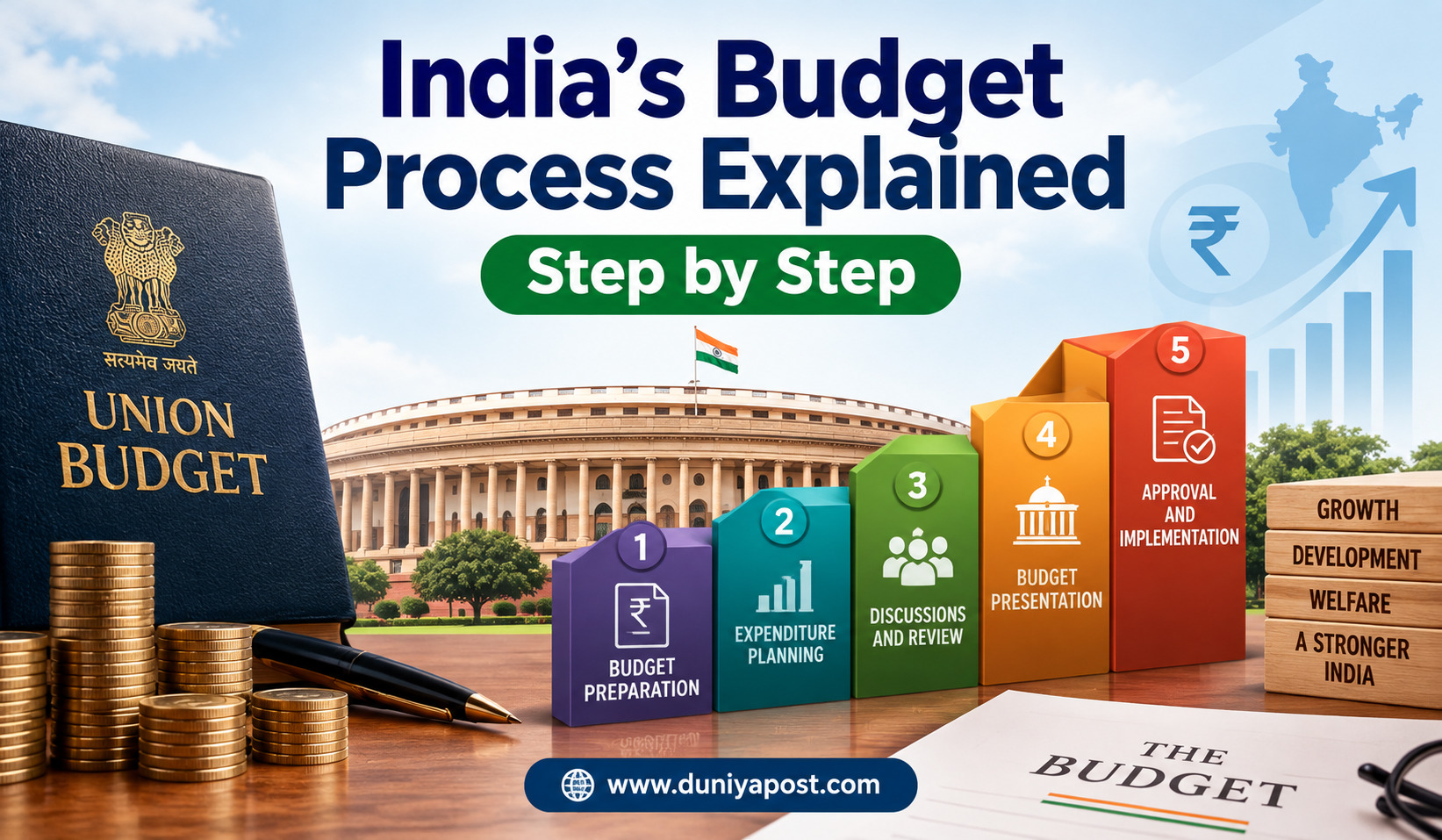
Every year, the Union Budget of India becomes one of the country’s most closely watched financial and economic events. It outlines how the government plans to raise revenue and allocate public money during the upcoming financial year. Decisions related to taxation, infrastructure, education, healthcare, agriculture, defence, employment, and social welfare can all be reflected in the Budget.
However, the India’s Budget process does not begin on Budget Day. The preparation starts months earlier and involves government departments, economic analysis, revenue and expenditure estimates, stakeholder consultations, parliamentary scrutiny, and legislative approval.
Understanding how the Union Budget is prepared and approved can help citizens understand how public money is managed and how government priorities are converted into financial plans.
What Is the Union Budget?
The Union Budget is the annual financial statement of the Government of India. It presents the government’s estimated receipts and expenditure for the upcoming financial year, which runs from 1 April to 31 March.
The Budget explains how the government expects to raise money through sources such as taxes, non-tax revenue, and borrowings. It also outlines planned expenditure on areas including infrastructure, defence, education, healthcare, agriculture, social welfare, transport, and other public services.
The Union Budget is therefore more than a statement of numbers. It reflects the government’s economic priorities and provides an indication of its development plans for the year ahead.
Why Is the Union Budget Important?
The Union Budget affects citizens, businesses, investors, and government institutions in several ways.
Government spending determines the resources available for roads, railways, schools, hospitals, rural development, digital infrastructure, and welfare programmes. Tax proposals can affect household finances and business costs, while investments in important sectors can support employment and economic activity.
For businesses, Budget announcements can influence taxation, investment conditions, infrastructure spending, exports, and sector-specific policies. For citizens, changes in taxes, public services, welfare programmes, and government investment can have both direct and indirect effects.
This makes the Union Budget one of the most important policy documents issued by the government each year.
How India’s Budget Process Works
The Indian Budget process involves several stages. Although the process is complex, it can be understood through the following major steps.
Step 1: Budget Preparation Begins Months in Advance
The Union Budget preparation process begins several months before its presentation in Parliament.
The Ministry of Finance coordinates the process by collecting financial estimates and proposals from different ministries, departments, and government agencies. Each department assesses its financial requirements for existing programmes as well as proposed initiatives for the coming financial year.
These proposals may cover expected expenditure, infrastructure requirements, programme priorities, and policy objectives.
At the same time, the Finance Ministry examines the country’s economic situation. Factors such as revenue collection, inflation, economic growth, fiscal conditions, and future economic expectations are considered while developing the Budget.
Step 2: The Government Consults Stakeholders
Budget preparation also involves consultations with different stakeholders.
Industry representatives, economists, agricultural experts, trade organizations, financial institutions, startups, business associations, and other groups may submit suggestions or raise concerns related to taxation, investment, employment, exports, and sector-specific issues.
These consultations can help policymakers understand challenges across different parts of the economy and identify areas where policy changes or government support may be required.
However, the final Budget decisions remain the responsibility of the government.
Step 3: Estimating Government Revenue
One of the most important stages in the Budget preparation process in India is estimating how much money the government is likely to receive during the next financial year.
Government receipts can come from several sources, including direct taxes, indirect taxes, customs duties, dividends from public sector enterprises, fees, and other non-tax revenue.
Borrowings can also be used to finance government expenditure when required.
Revenue forecasting is important because the government’s spending plans depend significantly on the financial resources available to it. Accurate estimates help policymakers plan expenditure while maintaining fiscal discipline.
Step 4: Planning Government Expenditure
After estimating expected revenue and available resources, the government develops its expenditure plans.
Public spending can cover areas such as:
- Education and healthcare
- Defence and national security
- Agriculture and rural development
- Roads, railways, and transport
- Scientific research and technology
- Housing and social welfare
- Digital infrastructure
- Environmental protection
The government has to balance competing priorities while considering its available resources and broader economic conditions.
Large infrastructure projects, welfare programmes, and public-service investments are assessed before financial allocations are finalized.
The objective is to use public resources effectively while supporting economic development and maintaining financial stability.
Step 5: Finalizing the Union Budget Documents
After extensive analysis, discussions, and consultations, the Ministry of Finance prepares the final Budget documents.
These documents contain financial estimates, taxation proposals, expenditure plans, policy announcements, and other supporting economic information.
Government officials coordinate extensively to ensure that financial figures, proposals, and policy priorities are properly reflected in the final documents.
The preparation process also involves a high level of confidentiality until the Budget is officially presented.
Step 6: The Union Budget Is Presented in Parliament
The Union Budget is presented in the Lok Sabha by the Union Finance Minister during the Budget Session of Parliament.
During the Budget speech, the Finance Minister explains the government’s assessment of the economy, highlights major policy initiatives, announces taxation proposals, and outlines important spending priorities for the upcoming financial year.
The Budget presentation marks the beginning of the formal parliamentary examination of the government’s financial proposals.
Step 7: Parliament Discusses the Budget
After the Budget is presented, Members of Parliament examine and discuss its proposals.
Parliamentary discussions can cover government expenditure, taxation measures, economic policies, and allocations for different sectors.
Members can raise concerns, ask questions, seek clarification, and discuss how proposed measures could affect citizens and the economy.
This stage is important because parliamentary discussion provides an opportunity for elected representatives to examine the government’s financial plans.
Step 8: Parliamentary Committees Examine Expenditure
After the general discussion, parliamentary committees examine the expenditure proposals of different ministries and departments in greater detail.
These committees study departmental financial requirements and submit reports to Parliament. Their examination allows Members of Parliament to look more closely at government spending proposals than is possible during general debates.
Committee scrutiny is therefore an important part of legislative oversight and helps support informed decision-making.
Step 9: Parliament Approves the Budget
After discussions and committee examination, the required financial legislation is considered through the parliamentary process.
Once the necessary constitutional and legislative approvals are completed, the government receives authorization to collect revenue and spend public funds according to the approved financial plans.
Parliamentary approval is a key feature of democratic financial accountability because government spending requires legislative authorization.
Step 10: The Government Implements the Budget
The Budget process in India does not end when Parliament approves the financial proposals.
Government ministries and departments begin implementing programmes, infrastructure projects, welfare schemes, and other initiatives according to the approved allocations.
During the financial year, government expenditure is monitored and reviewed to ensure that public money is being used for approved purposes.
Financial and administrative oversight mechanisms also help assess how effectively government programmes are being implemented.
How the Union Budget Affects Citizens?
The Union Budget can influence everyday life in several ways.
Government investment in infrastructure can improve transportation and public services. Higher allocations for healthcare and education can strengthen public institutions, while spending on agriculture and rural development can support communities and economic activity.
Taxation decisions can affect personal finances, business costs, and consumer spending. Similarly, investment in digital infrastructure, renewable energy, technology, and scientific research can influence India’s long-term economic development.
The impact of the Budget may therefore be both immediate and long term.
Challenges in India’s Budget Planning
Preparing a national budget for a large and diverse country like India is a complex task.
The government must balance development priorities with available financial resources while considering economic growth, inflation, fiscal discipline, global economic conditions, and public expectations.
Unexpected developments can also create challenges. Natural disasters, health emergencies, international economic disruptions, changes in commodity prices, or other unforeseen events can affect government finances during the financial year.
For this reason, effective budget management requires careful planning, continuous monitoring, and the ability to respond to changing economic conditions.
Why Transparency Matters in the Budget Process?
Transparency is an important part of India’s public financial system.
The presentation of the Budget in Parliament, parliamentary debates, committee examination, official Budget documents, and subsequent financial reporting allow citizens and other stakeholders to understand how public money is planned and spent.
Greater transparency strengthens accountability and can help build public confidence in government financial management.
An informed public can also better understand government priorities and participate in discussions about taxation, public spending, economic policy, and national development.
Conclusion
The India’s Budget process is much more than the annual presentation made by the Finance Minister. It is a detailed process that begins months in advance and involves financial planning, revenue estimation, expenditure decisions, stakeholder consultations, parliamentary scrutiny, legislative approval, and implementation.
From estimating government revenue to deciding how public money should be allocated, every stage plays an important role in managing the country’s financial resources.
The Union Budget influences areas ranging from education and healthcare to infrastructure, agriculture, technology, employment, and social welfare. Understanding how India’s Budget process works gives citizens a clearer view of how government priorities are converted into financial decisions.