
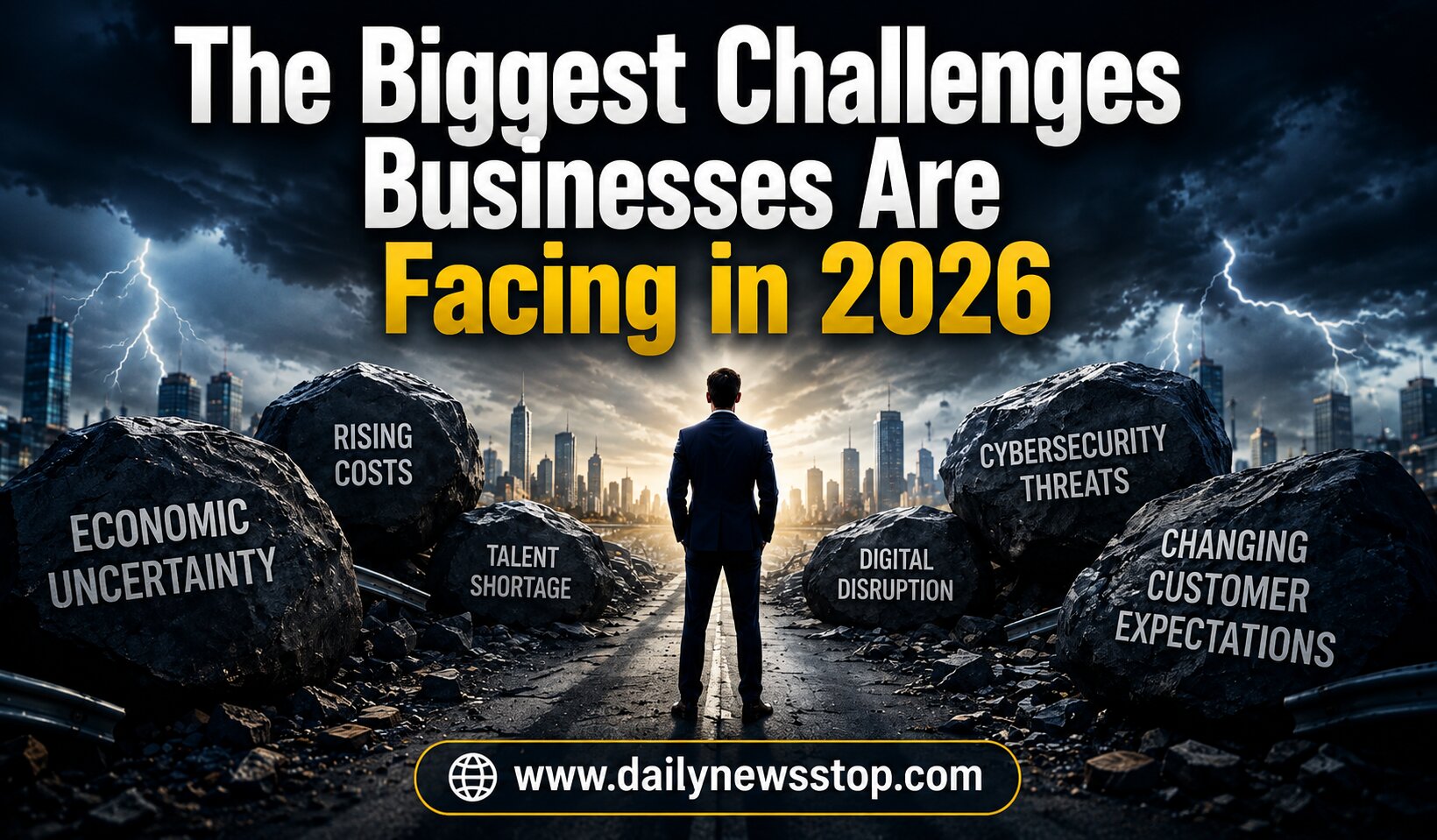
Ask a CEO what kept them up at night in 2021 and you’d likely hear “inflation” or “supply chains.” Ask the same question in 2026, and the answer has broadened considerably. Executives are now juggling a fragile economy, geopolitical instability, a genuine gap between what AI promises and what it delivers, escalating cyber threats, and a workforce that’s harder to plan around than ever. Small business owners, meanwhile, are fighting a more grounded version of the same battle: rising costs, thin margins, and too many tools competing for too little attention. Here’s a look at what’s actually keeping businesses under pressure this year, and why several of these challenges are more connected than they first appear.
1. Economic Fragility Hasn’t Gone Away, It’s Just Changed Shape
Inflation dominated boardroom conversations for years after the pandemic, and while it’s no longer the single biggest worry it once was, economic uncertainty hasn’t disappeared it’s simply broadened. The Conference Board’s 2026 C-Suite Outlook, which surveyed over 1,700 executives, found a fragile economy remains one of the top concerns alongside geopolitical instability, workforce issues, and regulation. For small businesses specifically, the pressure is more direct: owners are contending with rising operational costs, tighter marketing budgets, and rapidly shifting customer demands all at once, in a market crowded enough that roughly half of small businesses don’t survive past five years.
2. Political And Geopolitical Disruption Has Climbed The Agenda
For the first time in several years of tracking executive sentiment, political disruption has risen to rival and in some surveys, surpass technology as the top challenge facing business leaders, according to Warwick Business School’s annual survey of C-suite executives and middle managers. Trade fragmentation, tariff volatility, and instability across multiple global flashpoints are forcing companies to build contingency planning into strategy in a way that wasn’t necessary a few years ago. This isn’t an abstract concern either: ongoing tariff volatility is directly cited as one of the forces compounding stress across global supply chains this year, alongside ocean freight rate instability and geopolitical fragmentation more broadly.
3. The AI Strategy Gap: Everyone’s Investing, Few Can Prove It’s Working
This might be the single most defining business challenge of 2026. Virtually every enterprise is investing in AI, but very few can point to measurable business outcomes from that investment. The problem isn’t a shortage of AI tools it’s a shortage of discipline in how they’re deployed. Without clear ownership, defined outcome metrics, and governance that ties AI initiatives back to strategic priorities, these investments tend to become scattered experiments rather than genuine competitive advantages.
Industry experts frame this as fundamentally a strategic alignment problem rather than a technology problem. As one software executive put it, organizations face the challenge of adopting technologies that don’t actually help them deliver their strategic outcomes and the risk isn’t the technology itself, but a lack of discipline in how it’s put to use. Companies that are pulling ahead tend to share a few habits in common:
- Clear line-of-sight between each AI initiative and a specific, measurable business outcome
- The discipline to stop funding AI projects that aren’t moving the metrics that matter
- Governance that distinguishes core strategic AI bets from adjacent, exploratory experiments
Businesses still treating AI adoption as a race to keep up, rather than a disciplined investment decision, are the ones most likely to end up with a lot of spending and little to show for it.
4. Cybersecurity Threats Are Escalating, Not Leveling Off
Cybersecurity remains one of the most consistently cited risks facing businesses in 2026, and it’s getting harder to manage rather than easier. As cybercriminals become more sophisticated, attacks like ransomware, phishing, and data breaches are increasing in both frequency and complexity. Adding to the concern, experts are specifically warning about the rise of AI-enhanced ransomware, where the same generative AI tools businesses are racing to adopt for productivity are also being weaponized against them. For companies of every size, this means cybersecurity can no longer be treated as a background IT function; it’s a front-line business risk that demands the same strategic attention as revenue growth or supply chain planning.
5. The Talent Mismatch Is Getting More Specific
Workforce challenges haven’t gone away either, but they’ve become more targeted. Rather than a generic talent shortage, executives are increasingly describing a specific mismatch: not enough people with the AI-related skills companies now need. This shows up as a persistent risk in major executive surveys and creates an awkward tension for many organizations — investing heavily in AI while simultaneously struggling to find or develop the people capable of deploying it effectively, governing it responsibly, and catching its mistakes. For businesses of all sizes, this is increasingly translating into a dual mandate: hire for AI-related skills where possible, and invest seriously in upskilling the workforce already in place, rather than assuming the technology alone will close the gap.
6. Supply Chains Remain Under Compounding Stress
Global supply chains haven’t stabilized so much as adjusted to a new baseline of stress. Tariff volatility, ocean freight rate instability, and geopolitical fragmentation are combining with customer expectations for real-time delivery transparency to create a genuinely harder operating environment than businesses faced just a few years ago. One recurring theme across supply chain research is that limited visibility across multi-modal transportation networks remains a foundational problem, and the businesses managing supply chains most successfully in 2026 tend to be the ones with centralized, real-time data across every leg of their logistics network, rather than fragmented visibility pieced together after the fact.
7. Regulation And Data Governance Keep Getting More Complex
As businesses collect and store more data than ever before, managing it securely and responsibly has become a genuinely complicated undertaking. Regulatory requirements, evolving data privacy expectations, and internal governance obligations are all converging at once, and this complexity compounds directly with the AI challenge described above — since much of the data driving new AI systems is also the data subject to the tightest regulatory scrutiny. Businesses that treat data governance as a compliance afterthought rather than a core operational discipline are increasingly finding it catches up with them.
8. Small Businesses Are Fighting A More Grounded Version Of All This
While large enterprises grapple with geopolitical strategy and AI governance frameworks, small business owners are dealing with a scaled-down but no less demanding version of the same pressures: cash flow, customer retention, hiring, and keeping up with technology, all while working with a fraction of the resources larger competitors have. The technology piece is particularly tricky for smaller operations — steep learning curves, high software costs, and general tool overload make it tempting to buy every new app on the market, which quickly drains budget and creates more confusion than it solves. For small business owners already wearing multiple hats, keeping up with something like AI adoption can feel overwhelming rather than empowering, even though the underlying opportunity is real.
Why are these challenges more connected than they look?
What’s notable about the 2026 business landscape is how interconnected these pressures have become. Cybersecurity risk is amplified by the same AI tools companies are racing to adopt. The AI skills gap makes it harder to close the AI strategy gap. Supply chain instability is partly a downstream effect of the same geopolitical fragmentation reshaping trade policy. None of these challenges sit in isolation anymore, which means solving one in a vacuum rarely produces the results a company expects.
The organizations navigating 2026 most successfully tend to share one underlying trait: the discipline to execute faster than the rate of change around them, translating strategy into aligned, measurable action instead of chasing every emerging trend or threat individually. That’s genuinely difficult in an environment where boards are impatient and markets are unpredictable, but it’s increasingly the real differentiator not access to more capital or more information, both of which are now widely available, but the ability to actually act on them with focus.
The Bottom Line
There’s no single fix for 2026’s business challenges, because there’s no single challenge it’s a tightly interwoven set of economic, technological, geopolitical, and human pressures all moving at once. The businesses handling it best aren’t the ones with the biggest budgets or the flashiest AI rollouts; they’re the ones treating every one of these pressures as connected rather than separate, and building the discipline to respond deliberately rather than reactively. In a year defined by disruption on nearly every front, that kind of clear-eyed prioritization may be the most valuable business skill of all.