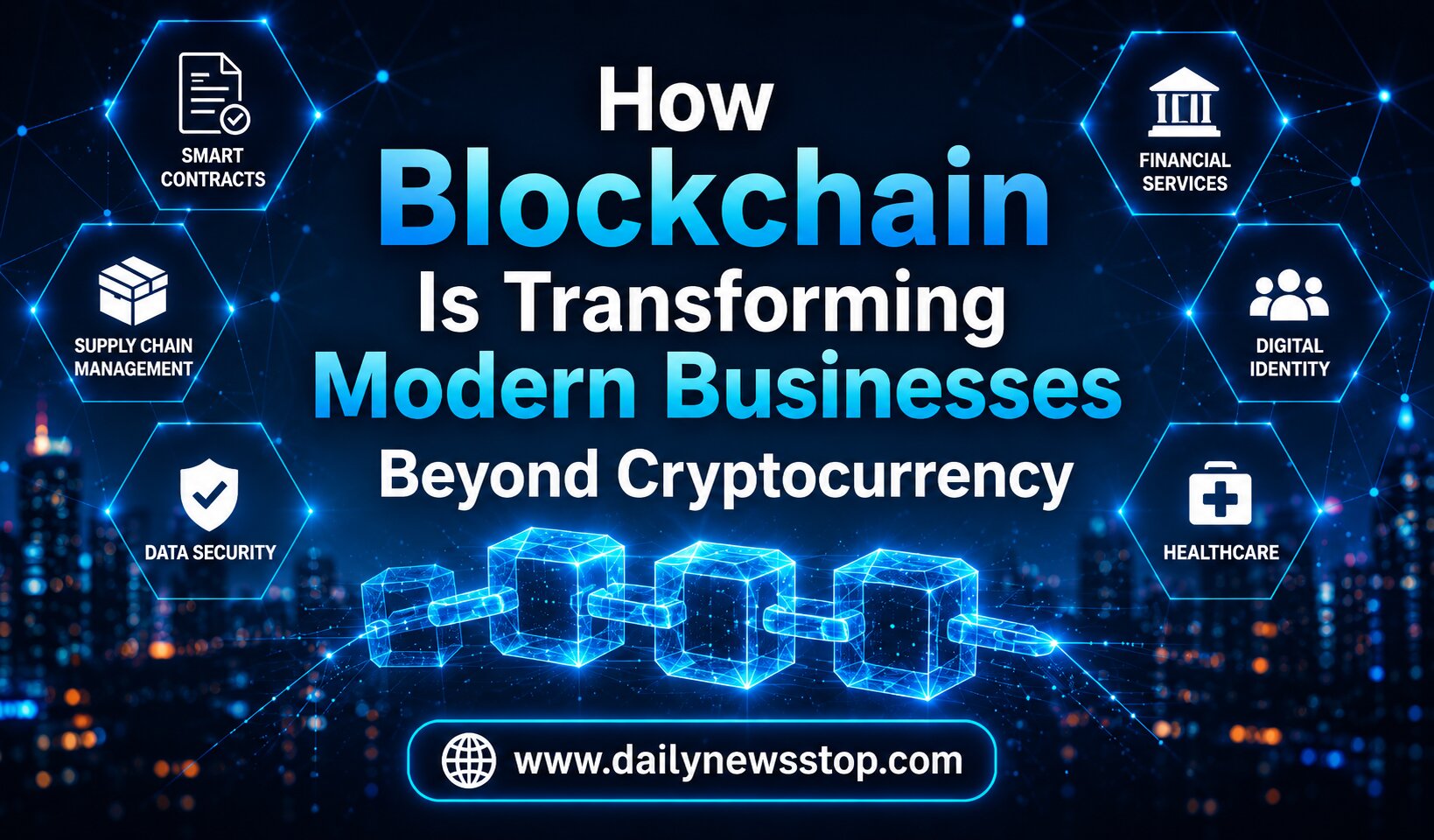
For most of the last decade, the word blockchain was closely associated with Bitcoin and cryptocurrency. Mention blockchain in a business meeting, and the conversation would often turn toward crypto trading or digital currencies.
While that association was understandable, it overlooked the broader potential of blockchain technology in business. At its core, blockchain is a shared and tamper-resistant digital ledger that allows multiple parties to securely agree on and verify information without depending entirely on a single central authority.
In 2026, businesses are increasingly recognizing this potential. Companies across finance, healthcare, logistics, manufacturing, government, and technology are exploring or implementing blockchain for practical business problems. Instead of treating blockchain as a cryptocurrency experiment, many organizations now view it as an infrastructure technology that can improve transparency, security, automation, and efficiency.
From Cryptocurrency to Business Infrastructure
The biggest change in the blockchain industry is the way businesses now approach the technology.
Earlier blockchain projects were often launched as experiments designed to test whether the technology could work outside cryptocurrency. Today, organizations are becoming more selective. They are using blockchain where it can solve a specific business challenge, particularly when several independent organizations need to share information and maintain a common record.
This makes blockchain in business especially useful for industries involving complex supply chains, financial transactions, digital credentials, contracts, and regulatory records.
The technology is particularly valuable when multiple parties need access to the same information but do not necessarily want one organization to control the entire database.
For example, a shipment may involve manufacturers, logistics companies, customs authorities, warehouses, insurers, and retailers. Instead of every organization maintaining separate records and repeatedly reconciling them, blockchain can provide a shared record that authorized participants can verify.
This shift from experimentation to practical infrastructure is helping blockchain move beyond its cryptocurrency image.
How Blockchain Is Being Used in Business?
Blockchain has applications across several industries. While not every project requires blockchain, the technology can provide significant advantages in situations where transparency, traceability, security, and multi-party verification are important.
1. Blockchain in Supply Chain and Logistics
Supply chain management is one of the most practical blockchain use cases for businesses.
Modern supply chains can involve dozens of companies across different countries. Tracking a product from its original source to the final customer can therefore become complicated.
Blockchain can create a shared record of important events throughout the supply chain. Businesses can record information about manufacturing, transportation, customs clearance, storage, and delivery on a distributed ledger.
This can make it easier to identify where a product came from and what happened to it during transportation.
The technology is particularly useful for products that require strict handling conditions. Pharmaceuticals, fresh food, and other temperature-sensitive goods may need detailed records showing how they were stored and transported.
Blockchain does not automatically guarantee that the original information is accurate, but once trusted data is recorded, it can provide a stronger and more transparent audit trail.
2. Healthcare Records and Digital Credentials
Healthcare organizations handle highly sensitive information and often rely on systems that do not communicate smoothly with one another.
Blockchain-based solutions can potentially help create secure records of access, transactions, and data sharing between authorized parties.
One potential application is giving patients greater control over how their information is shared between healthcare providers. Instead of repeatedly transferring records manually, authorized providers could verify access permissions through a blockchain-supported system.
Blockchain is also being explored for digital credentials.
Universities and other institutions can issue digitally verifiable certificates that employers or other organizations can authenticate without relying entirely on manual verification.
This could make the verification of degrees, professional qualifications, and other credentials faster and more reliable.
3. Cross-Border Payments and Financial Transactions
Finance remains one of the most important areas for blockchain technology in business.
Traditional international payments can involve multiple intermediaries, which can increase processing times and costs. Blockchain-based payment networks can potentially reduce some of these steps by allowing transactions and settlement to occur through digital infrastructure.
Stablecoins and other blockchain-based payment systems are also attracting attention for international transactions and remittances.
For businesses operating across multiple countries, faster settlement can improve cash flow and reduce some of the administrative complexity associated with international payments.
However, blockchain-based financial systems still operate within regulatory, compliance, and security requirements. Businesses therefore need to evaluate the legal and operational environment before adopting these solutions.
4. Smart Contracts and Business Automation
Smart contracts are another important blockchain application.
A smart contract is software stored on a blockchain that can automatically execute predefined actions when specified conditions are met.
For businesses, this can reduce the need for manual processing in certain workflows.
For example, an insurance-related smart contract could automatically initiate a payment when verified conditions are satisfied. Similarly, blockchain-based systems could help automate royalty payments, supplier agreements, or other transactions.
The major advantage is not simply automation. Smart contracts can also create a transparent record of when agreed conditions were fulfilled and when an automated action occurred.
5. Digital Identity and Access Management
Businesses and governments often maintain separate identity databases. This can create duplication and make verification more complicated.
Blockchain-based digital identity systems aim to provide individuals and organizations with verifiable digital credentials that can potentially be used across different services.
For example, a customer could verify certain information during financial onboarding without repeatedly submitting the same documents to different organizations.
However, blockchain should not be viewed as a complete solution to identity management. Privacy, data protection, user control, and regulatory compliance remain essential considerations.
6. IoT and Data Integrity
The Internet of Things is generating massive amounts of data through connected sensors and devices.
Factories, warehouses, vehicles, farms, and logistics networks can collect information about temperature, location, equipment performance, and operating conditions.
Blockchain can help create a tamper-resistant record of selected events generated by these systems.
For example, a logistics company could record temperature readings from sensors during the transportation of sensitive products. Authorized participants could then verify the recorded history.
The value comes from creating a reliable audit trail rather than simply storing every piece of IoT data on a blockchain.
7. Asset Tokenization
Asset tokenization is another area attracting growing attention.
Physical or financial assets such as real estate, commodities, securities, and collectibles can potentially be represented through blockchain-based digital tokens.
Tokenization can make it possible to divide ownership into smaller digital units and potentially simplify certain aspects of transferring ownership.
For businesses and investors, this could create new models for accessing and managing assets.
However, tokenized assets still need to comply with applicable financial, property, and securities regulations. Blockchain technology alone does not remove those legal requirements.
Blockchain and Artificial Intelligence: A New Business Use Case
One of the more interesting developments is the growing connection between blockchain and artificial intelligence.
Blockchain is not necessarily being used to make AI systems more intelligent. Instead, it can potentially help businesses improve accountability and traceability around AI systems.
As companies increasingly use AI for recruitment, lending, customer service, content generation, and decision-making, questions about data provenance and accountability are becoming more important.
Businesses may need to know where certain datasets came from, when information was recorded, and how different versions of an AI model were developed.
Blockchain can potentially provide a tamper-resistant record of important events and data provenance.
For example, an organization could record information about the origin of a dataset, model versions, approvals, or timestamps on a blockchain-supported system.
This does not solve every AI governance problem, but it could provide an additional layer of verification and accountability.
As AI regulations and governance frameworks continue to develop, this could become an important blockchain use case for enterprises.
Why Are Businesses Adopting Blockchain?
The growing interest in blockchain is not simply the result of technology hype. Several practical factors are encouraging organizations to consider it.
Growing Need for Transparency
Businesses increasingly need reliable records that can be audited by regulators, partners, customers, and internal teams.
Blockchain can provide a shared history of transactions and events that is difficult to alter after the fact.
Complex Multi-Party Processes
Blockchain is particularly useful when several independent organizations need to agree on the same information.
Instead of maintaining separate databases and repeatedly comparing records, participants can work from a shared ledger.
Improved Enterprise Blockchain Solutions
Early blockchain systems were often designed around public, permissionless networks. These models created challenges for businesses that needed greater privacy, control, and regulatory compliance.
Today, organizations can choose from different blockchain architectures, including private and consortium-based systems.
This gives enterprises greater control over who can participate and what information can be accessed.
Better Scalability
Blockchain technology has also evolved significantly.
Newer architectures and infrastructure approaches aim to improve transaction speed, reduce costs, and make blockchain systems more practical for larger workloads.
However, scalability remains an important consideration, and businesses should evaluate blockchain performance based on their specific requirements rather than assuming that every blockchain network can handle enterprise workloads.
Blockchain Is Not the Solution to Every Business Problem
Despite its potential, businesses should not adopt blockchain simply because it is a popular technology.
A traditional database may be faster, cheaper, and easier to maintain when a single organization controls the data and there is no need for multiple parties to share a trusted record.
Blockchain becomes more valuable when several organizations need to coordinate information but do not want to rely completely on one central authority.
Another important issue is data quality. Blockchain can make recorded information difficult to alter, but it cannot automatically determine whether the original information was correct.
If incorrect data enters the system, blockchain may simply preserve that incorrect information.
For this reason, successful blockchain implementation in business requires more than choosing a technology. Organizations also need reliable processes, governance frameworks, security controls, and clear business objectives.
What Is the Future of Blockchain in Business?
The future of blockchain is likely to look very different from the early cryptocurrency-focused narrative.
Instead of attempting to transform every industry, blockchain is becoming increasingly focused on specific business problems where shared trust, transparency, verification, and automation provide measurable value.
A company may use blockchain to track a shipment across several countries, verify a professional credential, settle an international transaction, automate a contractual payment, or maintain a verifiable record of important AI-related data.
These applications may not generate the same excitement as cryptocurrency price movements, but they could have a more lasting impact on everyday business operations.
As businesses become more comfortable with blockchain infrastructure, its use could expand across supply chains, finance, healthcare, government services, digital identity, asset management, and emerging technologies.
Conclusion
Blockchain in business has moved well beyond its original association with Bitcoin and cryptocurrency.
The technology is increasingly being considered for practical applications where multiple parties need to share information, verify transactions, automate agreements, or maintain a reliable audit trail.
From supply chain tracking and cross-border payments to smart contracts, digital identity, asset tokenization, and AI accountability, blockchain offers businesses new ways to approach complex coordination problems.
At the same time, blockchain is not a universal replacement for traditional databases or existing business systems. Its value depends on choosing the right use case and having a clear reason for using distributed ledger technology.
The most promising future for blockchain may therefore be its least flashy one: becoming reliable, specialized infrastructure that businesses use quietly in the background.
As organizations move away from blockchain hype and focus more on measurable business value, the technology’s role in modern enterprises could continue to grow far beyond the cryptocurrency story that first made it famous.