Running a small business has never been easy, but in 2026 the pressure is greater than ever. Rising operational expenses, higher customer expectations, and increasing competition from digital-first companies are forcing entrepreneurs to find smarter ways to manage their resources. Hiring more employees is not always an option, and cutting costs without affecting product quality or customer service can be a difficult balance to achieve. This is where Artificial Intelligence (AI) automation is making a real difference.
AI is no longer a futuristic concept reserved for multinational corporations. Affordable AI-powered tools are now helping small businesses automate routine tasks, improve efficiency, and reduce unnecessary expenses. From customer support and marketing to accounting and inventory management, AI enables businesses to do more with fewer resources. As a result, many startups and local businesses are discovering that automation is not just about saving time it is becoming an important strategy for long-term profitability.
Why AI automation matters for small businesses?
For many years, automation was considered expensive and complicated to implement. Small businesses often lacked the budget and technical expertise needed to adopt advanced software solutions. However, the rapid growth of cloud-based AI platforms has changed that situation. Today, businesses can subscribe to AI services on a monthly basis without making large upfront investments.
The biggest advantage of AI automation is its ability to handle repetitive work consistently and accurately. Instead of spending hours on manual data entry, scheduling appointments, responding to common customer questions, or preparing reports, business owners and employees can focus on activities that directly contribute to growth. This shift not only improves productivity but also reduces operating costs over time.
In an environment where every expense affects profitability, using AI to eliminate inefficient processes can provide a significant competitive advantage.
Reducing Customer Service Costs Without Compromising Quality
Customer service is one of the areas where AI automation delivers immediate value. Many small businesses struggle to respond quickly to customer inquiries because they cannot afford to maintain a large support team. Delayed responses often result in lost sales and dissatisfied customers.
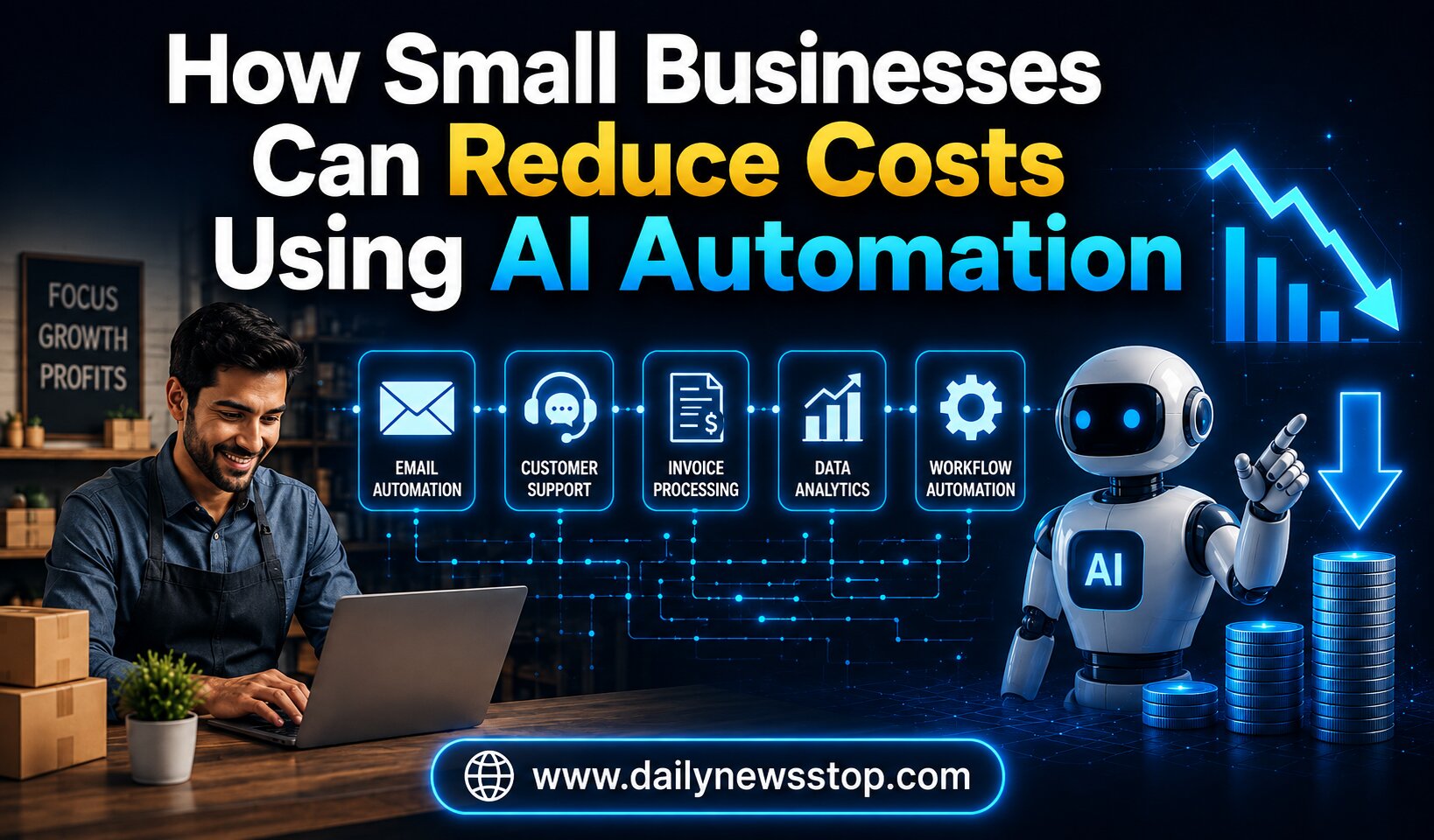
AI-powered chatbots are helping solve this problem by handling routine questions around the clock. Whether customers want to check an order status, understand a return policy, book an appointment, or learn more about a product, AI assistants can provide instant answers without human intervention.
This does not eliminate the need for customer service representatives. Instead, it allows employees to focus on more complex issues that require human judgment and empathy. By reducing the workload on support teams, businesses can improve response times while lowering staffing costs.
AI Is Changing the Economics of Marketing
Marketing is another area where small businesses often spend a large portion of their budget. Hiring writers, designers, social media managers, and advertising specialists can quickly become expensive, particularly for startups.
AI has made marketing more accessible by assisting with content creation, campaign planning, email marketing, keyword research, and performance analysis. Business owners can generate blog ideas, write product descriptions, create social media captions, and draft promotional emails in a fraction of the time previously required.
More importantly, AI can analyze customer behavior and campaign performance to identify what works and what doesn’t. Instead of spending money on ineffective advertisements, businesses can optimize their marketing strategies using real-time insights. This leads to better results while reducing unnecessary advertising expenses.
Smarter Inventory Management Saves Money
Inventory mistakes can have serious financial consequences. Overstocking ties up valuable capital, while understocking leads to missed sales opportunities and disappointed customers. Predicting demand accurately has always been challenging, especially for smaller retailers and e-commerce businesses.
AI-powered inventory systems are helping businesses make more informed decisions by analyzing sales history, seasonal trends, purchasing patterns, and market demand. These systems can forecast future inventory requirements with impressive accuracy, reducing waste and improving cash flow.
For businesses dealing with physical products, this level of forecasting can significantly reduce storage costs and minimize losses caused by unsold inventory.
Automating Administrative Work Improves Efficiency
Administrative tasks may seem minor individually, but together they consume a considerable amount of time every week. Scheduling meetings, organizing documents, preparing invoices, managing calendars, and updating customer records are essential responsibilities that often distract business owners from strategic work.
AI automation can complete many of these tasks automatically, reducing manual effort and minimizing human errors. Employees spend less time handling paperwork and more time serving customers, developing products, or exploring new business opportunities.
The savings generated by improved productivity often exceed the cost of implementing automation tools.
Financial Management Becomes Simpler with AI
Managing finances accurately is essential for every business, yet bookkeeping and accounting remain time-consuming activities. Manual calculations, invoice processing, and expense tracking increase the risk of mistakes that may lead to financial losses or tax complications.
Modern AI accounting software simplifies these processes by automatically categorizing expenses, generating invoices, reconciling bank transactions, and preparing financial reports. Business owners receive up-to-date insights into their financial health without spending hours reviewing spreadsheets.
This automation reduces dependence on manual bookkeeping while allowing businesses to make faster and better-informed financial decisions.
Helping Small Teams Achieve More
One of the biggest misconceptions about AI is that it replaces employees. In reality, most small businesses use AI to enhance employee productivity rather than reduce headcount.
When repetitive tasks are automated, employees can dedicate their time to creative work, customer relationships, business development, and strategic planning. A small team equipped with effective AI tools can often achieve the same level of productivity as a much larger workforce.
For businesses operating on limited budgets, increasing employee efficiency without increasing payroll expenses is one of AI’s greatest advantages.
Better Business Decisions Through Data
Many businesses collect valuable information every day but struggle to transform it into actionable insights. Sales figures, customer preferences, website traffic, and marketing performance all generate data that can guide business decisions.
AI analyzes this information much faster than traditional methods. It identifies trends, predicts future demand, highlights customer preferences, and detects opportunities that may otherwise go unnoticed.
Instead of relying solely on intuition, business owners can use data-driven recommendations to improve pricing strategies, marketing campaigns, and inventory planning. Better decisions often translate directly into lower costs and higher profits.
Real-World Adoption Continues to Grow
Across industries, small businesses are finding practical ways to integrate AI into their daily operations. Retail stores are using AI to forecast inventory demand and personalize customer recommendations. Restaurants are automating reservations and online ordering systems to improve efficiency. Service-based businesses are streamlining appointment scheduling, customer communication, and billing processes.
E-commerce companies have been among the fastest adopters of AI automation. They use AI to recommend products, optimize pricing, detect fraudulent transactions, and improve customer support. These improvements not only reduce operational costs but also enhance the overall shopping experience, leading to higher customer satisfaction and repeat purchases.
The growing availability of affordable AI platforms means that even home-based businesses can now access technology that was once available only to large enterprises.
Challenges Businesses Should Consider
Although AI automation offers numerous advantages, successful implementation requires careful planning. Businesses should avoid trying to automate every process immediately. Instead, they should identify repetitive tasks that consume the most time and gradually introduce automation where it provides the greatest value.
Human oversight remains important. AI systems are highly capable, but they are not perfect. Business owners should continue reviewing important financial reports, customer communications, and strategic decisions rather than relying entirely on automation.
Employee training is another essential factor. Staff members need to understand how AI tools work so they can use them effectively and confidently. Businesses that combine AI technology with skilled employees typically achieve the best long-term results.
The Future of Cost Reduction Through AI
The role of AI in small business operations is expected to expand significantly over the next few years. As technology becomes more advanced and affordable, automation will move beyond routine tasks into areas such as predictive business planning, personalized customer experiences, financial forecasting, and intelligent decision support.
Businesses that begin adopting AI today will be better prepared to compete in an increasingly digital economy. Those that delay adoption may find it difficult to match the efficiency and lower operating costs achieved by competitors using automation.
Rather than replacing entrepreneurship, AI is becoming a valuable business partner that allows owners to focus on innovation, customer satisfaction, and long-term growth.
Conclusion
AI automation has become one of the most practical tools available for small businesses looking to reduce costs without compromising quality or customer experience. By automating routine tasks, improving operational efficiency, and providing valuable business insights, AI helps entrepreneurs make better use of limited resources while increasing productivity.
The most successful businesses are not necessarily those with the largest budgets but those that use technology wisely. Whether it is automating customer support, streamlining accounting, improving inventory management, or enhancing marketing performance, AI offers cost-saving opportunities across nearly every aspect of business operations.
As AI continues to evolve, its accessibility and affordability will encourage even more small businesses to embrace automation. For entrepreneurs willing to adapt, AI is no longer just an emerging technology it is becoming a key driver of sustainable growth and long-term business success.